
Where FCADC Releases Go
The Frederick County Adult Detention Center is the county’s main adult jail. Its Corrections Bureau population includes people awaiting trial, people serving local terms, and people held for another authority. A direct community release may follow bond, recognizance, a pretrial order, dismissal, time served, sentence expiration, parole, or another lawful direction. The release entry should show the actual date, time, authority, and any destination recorded.
Not every departure is a community release. A move to the Maryland Department of Public Safety and Correctional Services, another county, the United States Marshals Service, or Immigration and Customs Enforcement continues custody elsewhere. The Sheriff’s 2023 report counted 93 releases to the Department of Corrections. Those people left FCADC, but they did not leave incarceration. Always ask “released to whom?”
A court release order and a physical community release are different events. Holds, processing, and transfers can intervene.
Confirm a Frederick County Release
Use the system that last held the person. Frederick County does not publish an official jail roster, 24-hour list, 72-hour list, or released-booking archive. The fastest county check begins with Offender Records, followed by a request for the underlying release-book entry.
- Gather the full name, date of birth, booking number, and arrest or admission date when known.
- Call FCADC Offender Records at 301-600-3015 and ask whether the person physically left.
- Ask whether the recorded destination was the community, Maryland DOC, ICE, or another custodian.
- Compare the answer with the matching Maryland court case.
- Use GovQuest to request the booking sheet and release-book entry.
The full county search and records path is also explained on the Frederick County released inmates home page. A VINE event can support the timeline, but it is not a historical release ledger.
FCADC Release Record Fields
A useful request names existing documents and fields. It should not ask staff to create a report or reach a legal conclusion. The following items distinguish a community return from a custody transfer.
| Field | What it establishes |
|---|---|
| Booking or local offender number | Connects the request to the correct custody episode. |
| Admission date and committing court | Links jail custody with the controlling case. |
| Sentence calculation | Shows credit, sentence structure, and the jail’s computed term. |
| Release date and time | Records when physical FCADC custody ended. |
| Release authority or type | Explains bond, court order, time served, sentence end, or another basis. |
| Transfer or detainer destination | Shows whether another agency took custody. |
Ask for segregable nonexempt portions if part of a file is withheld. Medical, victim, juvenile, sealed, investigatory, and other protected information may be redacted under Maryland law.
FCADC Sentence and Release Calculations
The jail’s own sentence calculation controls a local Frederick County term. The 2023 report recorded 684 sentence calculations, showing that this is a real FCADC records function. A useful calculation can include the sentence start, credit for time already served, concurrent or consecutive terms, and any local detention credits that apply. It is different from the later release-book entry. The calculation forecasts the term; the release entry documents what happened.
Maryland local detention credits are addressed in Correctional Services Title 11, Subtitle 5. Their treatment is separate from the statewide prison-credit rules. Do not apply a flat percentage or a state-prison formula to a county sentence. Court amendments, warrants, detainers, disciplinary action, or a transfer can also change the expected path. Request the current calculation rather than doing arithmetic from a docket summary.
A pretrial detainee often has no sentence-based release date at all. The next event may depend on bond, bail review, trial, a plea, or another court decision. Even after authority is entered, FCADC must finish checks and processing. That is why the expected date, legal authority, and physical release time should be recorded as three distinct facts.
Frederick County Records Contact
The facility and records contacts serve different needs. Call the jail for a prompt status question. Use the Sheriff’s public-records channel for a durable document.
Frederick County Adult Detention Center7300 Marcie’s Choice Lane
Frederick, MD 21704
Main: 301-600-2550
Offender Records: 301-600-3015
Administrative hours: Monday through Friday, 8 a.m. to 4 p.m.
The FCSO records page routes requests through GovQuest and lists help at 301-600-1740. In-person records assistance is at 110 Airport Drive East, Frederick, MD 21701. Request electronic delivery and a fee estimate before staff incur charges above a limit you choose.
The posted schedule lists a $5 electronic incident report of up to 20 pages, $0.25 for each added page, a $5 photograph charge, and a $3.50 GovQuest convenience fee. Disclosure still depends on the record and applicable exemptions.
Booked Versus Frederick County Committed
Central Booking is a unit inside FCADC, not a separate jail. The 2023 Corrections Bureau report says it processed 2,503 people from several local and state police agencies. Only 1,244, or 49.70 percent, were committed to the detention center. A booking record therefore does not prove a person joined the standing jail population.
For a short post-arrest sequence, request the booking sheet, initial appearance or court entry, and release record. That combination shows whether the person left after processing or after a period of committed detention.
Frederick Courts After FCADC Release
Maryland Judiciary Case Search often remains available after a short FCADC stay. It can show the case, charge-level disposition, sentence, and later docket activity. Frederick’s District and Circuit courts share the courthouse at 100 West Patrick Street, but their roles differ. District Court handles misdemeanors and certain felonies without jury trials. Circuit Court handles jury and felony matters within its jurisdiction.
A recognizance order, bond entry, dismissal, or time-served sentence may explain the legal basis for release. It does not normally state when the person crossed out of jail custody. Compare the docket with the release book. Frederick criminal Case Search coverage starts March 13, 2000, but public access can be limited by expungement, shielding, law, or court rule.
The courthouse Help Center offers free limited expungement help on weekdays. The Sheriff’s report counted 341 expungements processed by Records in 2023. A missing older public result may therefore reflect lawful removal. It cannot safely be treated as proof that no booking or detention ever occurred.
FCADC Release to ICE
Frederick’s 287(g) Jail Enforcement agreement makes the custody destination vital. The agreement addresses service of immigration warrants at scheduled release from criminal custody. An official Sheriff example describes people granted recognizance who remained held on immigration detainers. In that setting, “released” can describe the criminal case while the person remains confined.
Call the FCADC ICE information line at 301-600-6829 after a suspected handoff. Then use the ICE Online Detainee Locator with the exact A-number and country of birth, or the exact name and country information. A missing locator result does not prove release because the tool covers current ICE custody within stated limits.
Note: Record the agency, time, and destination given by staff, then request the detainer disposition or transfer entry for lasting proof.
FCADC History and Release Tracking
The Sheriff’s annual report states that the original detention center opened in October 1984 and was expanded or remodeled in 1996 and 1997. A 128-bed Work Release Center opened nearby in 2005. The report placed total correctional capacity at 468, divided among general-population, special-unit, and work-release spaces.
The same 2023 report described a planned Black Creek jail-management system intended to track a stay from intake through release. It also discussed a medical addition and later infrastructure work. These are report-era plans, not verified 2026 completion claims. The reliable present step remains asking FCADC which system record documents the event.
The official Adult Detention Center page shows the facility context captured below.
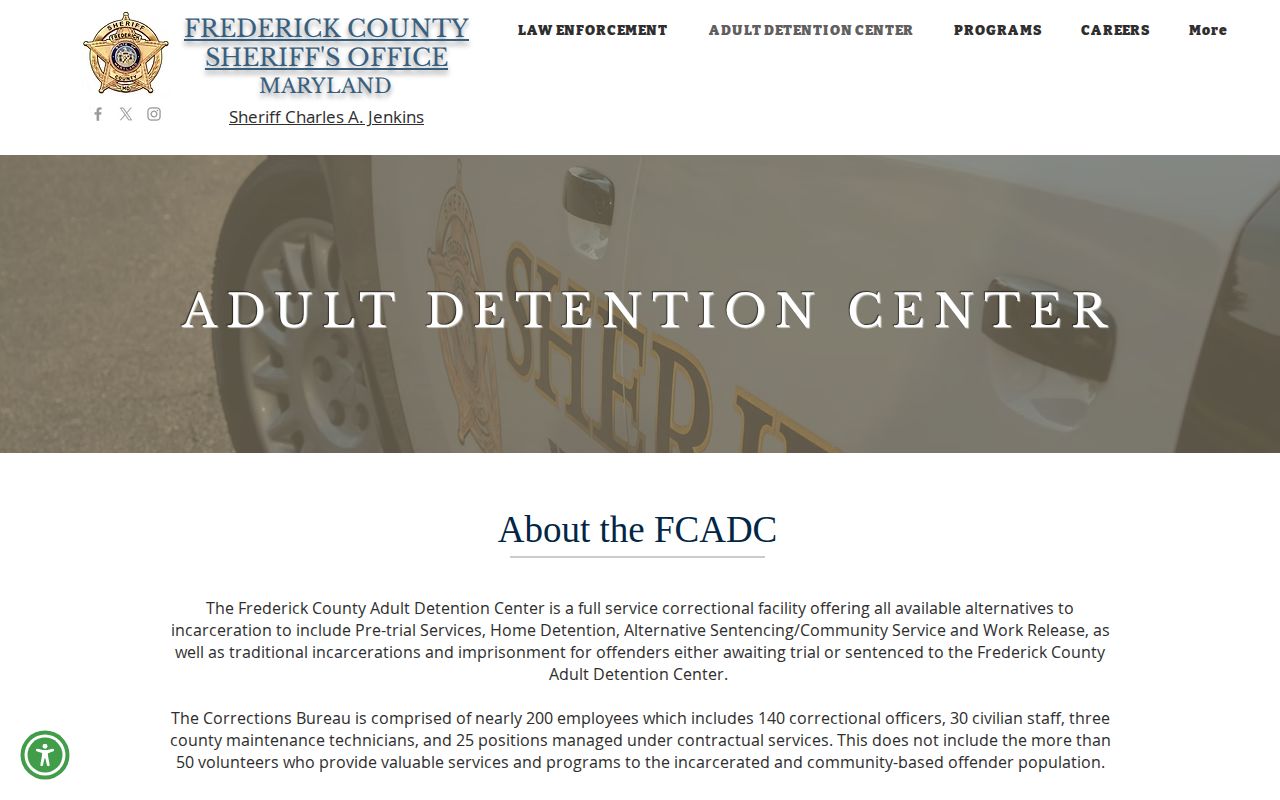
The page confirms the Sheriff’s facility and program role, while the release-book request supplies the person-level release evidence.
Frederick County Release Terms
Closely related terms do not mean the same thing. Reading them precisely prevents a transfer or supervised placement from being mistaken for full discharge.
- Recognizance
- A court-authorized release without a cash bond, still subject to processing and holds.
- Transfer
- The end of one facility’s custody while another authority takes control.
- Parole
- Conditional release from confinement while the sentence continues under supervision.
- Probation
- Court-ordered supervision that may follow or replace confinement.
- Time served
- A sentencing result that still requires the jail’s actual release time.
- Detainer
- A request or authority that may keep custody in place or cause a handoff.
Neither a missing online result nor a court order is enough by itself. Reconcile the facility record, court case, and destination system.