
Frederick County 72-Hour List Status
No official Frederick County Sheriff rolling 72-hour release view was located in the official web sweep completed July 23, 2026. The Sheriff's detention pages do not offer a current roster, a released-booking archive, or a date filter for recent departures. As a result, there is no official three-day URL, published set of columns, update cadence, photo field, or stated retention window to describe.
A three-day review remains possible, but it is assembled from source records. The key is to define the beginning and end of the time period and keep each custody episode separate. Court orders can be entered before the detention center completes processing. A VINE event may post on another schedule. An internal release-book entry is the best jail-side evidence, while the destination tells whether the person returned to the community or continued in another agency's custody.
Review Frederick Releases Across Three Days
Build the date range first. Include the date and time at both ends, not merely three calendar labels. Then identify the person and booking episode. The FCSO detention directory lists Offender Records at 301-600-3015 and the Adult Detention Center main line at 301-600-2550. Staff may limit what they disclose by phone, but a focused question can distinguish a physical departure from a transfer.
- Search the matching criminal case for orders and docket activity within the chosen range.
- Call Offender Records with the full name and another identifier if available.
- Ask for the actual departure date and whether FCADC released or transferred the person.
- Review VINE for an event tied to the correct person and reporting agency.
- Check Maryland DOC, ICE, federal, or another county system when the destination points there.
- Submit a narrow request for the release-book entry or an existing extract covering the period.
This order avoids a common error. A court entry proves legal action, not the moment the jail door cycle ended. A VINE alert reflects the reporting agency's status, not all possible holds. The release book supplies the local processing record. The Released Last 24 Hours page uses a tighter same-day method when a three-day range is not needed.
Frederick 72-Hour Release Record Fields
Frederick County publishes no online list columns. The table therefore identifies the fields that make an existing release record or log extract useful. Ask only for fields the Sheriff maintains. A records custodian may redact protected content or explain that a requested field does not exist in the form described.
| Field to request | Why it matters across three days |
|---|---|
| Legal name and date of birth | Separates people who share a similar name. |
| Booking or local offender number | Keeps multiple custody episodes from being merged. |
| Admission date and time | Shows whether the event began inside the selected range. |
| Actual release date and time | Places the physical FCADC departure within or outside the range. |
| Release type or authority | Explains bond, recognizance, court order, time served, sentence end, parole, or other basis. |
| Transfer destination | Distinguishes community return from continued custody. |
| Detainer disposition | Shows whether another authority affected the departure. |
| Court and case number | Links the jail entry to legal authority and later docket events. |
Frederick's release evidence can be spread among a booking sheet, commitment, sentence calculation, internal release book, detainer record, transfer record, and court case. One row may not carry the whole explanation. A transfer means release from FCADC's physical ledger, not freedom from confinement. Parole is conditional release under supervision. Time served describes a sentence result, while the facility record supplies the actual departure time.
Frederick Weekend Release Verification
A 72-hour window is practical when several days must be reconciled, especially when a next-business-day court event falls near a weekend or holiday. It does not create facts that the official sources do not provide. No Frederick source reviewed states that releases occur in the morning, gives a set exit door, promises a family waiting area, or describes a standard property-return schedule. Live logistics questions belong with the Shift Commander at 301-600-3012 or the jail main line.
Review the exact docket timestamps and the full range. A Friday order can be followed by later jail processing. A person may also be held for another authority after a court approves release in the local case. If the range includes a transfer, record both the time FCADC custody ended and the agency that received the person. This keeps a three-day result from turning a custody handoff into a false community release.
Note: A three-day window helps organize several sources, but Frederick County has not published a weekend or holiday release schedule to apply.
Frederick Release Book Versus Feed
The county's distinctive fact is the gap between public display and internal records. The official Adult Detention Center page exposes no recent-release list. Yet the 2023 Corrections Bureau report counted 412 release-book updates. The proper response is to seek the entry, use phone verification, and compare court and VINE events. It is not proper to relabel a private current-custody page as an official Frederick release feed.
The Maryland Public Information Act allows a request for existing agency records. It does not require FCSO to create a new rolling 72-hour report. A requester can ask whether a release log or release-book extract already exists for a narrow period and request segregable public fields. Segregable means nonexempt material that can be separated from protected content. Names or other details may be redacted when law requires or permits it, and fees can apply.
Note: Request an existing narrow-range extract if one exists, since the Sheriff need not create a new three-day release report.
Request Frederick Three-Day Release Records
The Sheriff's records and public information page explains the agency request route. A useful request gives the exact date and time range, facility, known person identifiers, and names of records sought. It can ask for existing release-book entries, booking sheets, actual release times, legal authority, destination, detainer disposition, and any linked booking number. Request electronic delivery and a fee estimate before the agency passes a limit you set.
The successful manifest image below shows the official FCSO records page used to reach the request process.
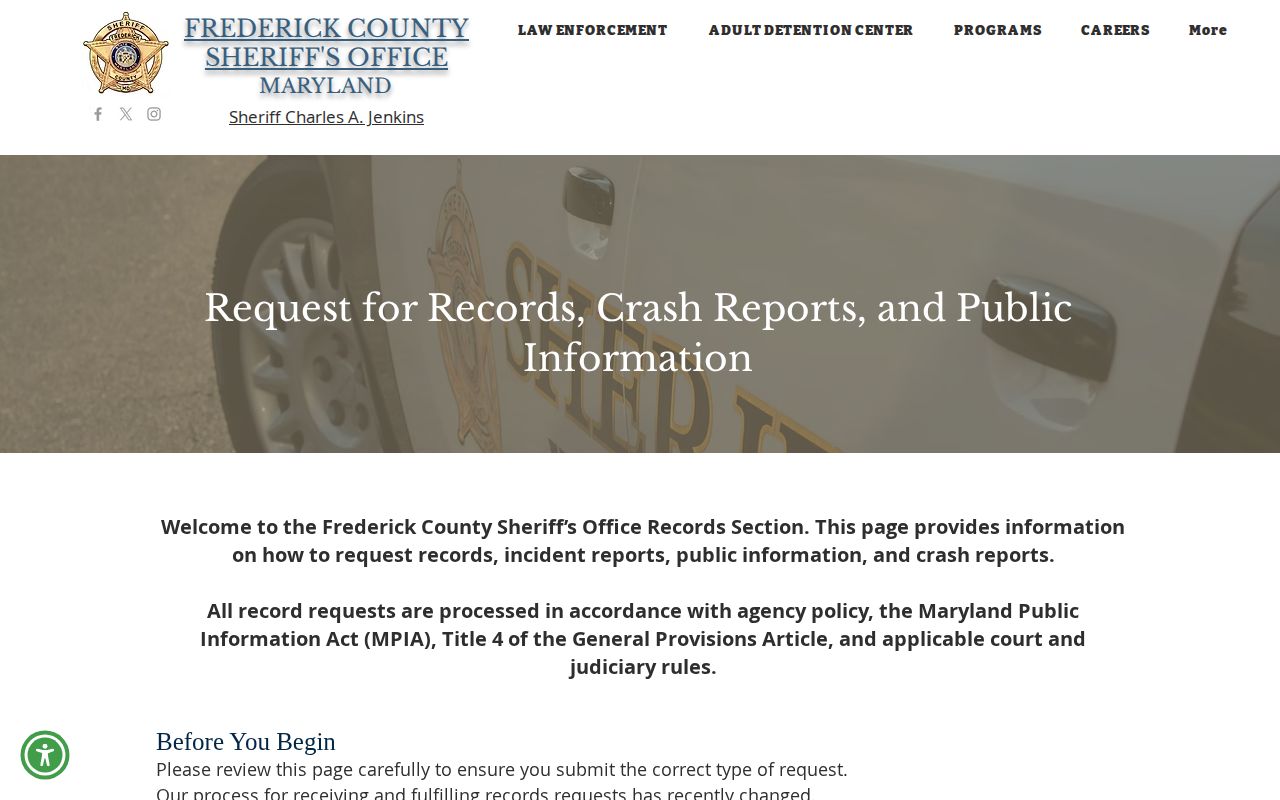
This channel preserves the three-day date range and the exact record names, which is more reliable than asking staff to create a general list.
If the request concerns one person, include full name, date of birth, booking number if known, and the custody start date. Ask whether the recorded destination was the community, Maryland DOC, another local jail, the US Marshals Service, or ICE. If the request concerns an existing log extract, make clear that no new report is requested. Agency review may result in redaction, an exemption explanation, fees, or a response that no responsive record exists.
Trace Frederick Releases After Transfer
The three-day window must follow the person into the correct system. A Maryland DOC transfer is a release from the county jail and continued state imprisonment. The DPSCS Incarcerated Individual Locator can show current facility placement for covered people, but it excludes people no longer in custody and does not offer a historical discharged result. A no-result cannot establish release. Use VINE, court history, the Division of Parole and Probation directory, and a focused DPSCS records request when facts remain unclear.
For ICE custody, use the ICE Online Detainee Locator when the person may be within its current scope. For federal imprisonment, the Bureau of Prisons locator can return a release date and a Released or Not in BOP Custody result. Neither result rules out another system. Frederick's 287(g) activity also makes destination important because release from criminal custody can become an immigration handoff. The release-book entry should identify that change when recorded.
Confirm a Frederick Named Release
A three-day review can fail when it begins with a list rather than a custody history. Start with the last known custodian and the exact person. Maryland Judiciary Case Search may preserve the case after the jail stay ends, but its order does not prove physical release. VINE may show a custody change, but registration must match the right person and agency. FCSO news posts can mention selected outcomes, yet they are not complete release data.
For a named person whose system is unknown, the Frederick County released inmates lookup separates county jail, Maryland DOC, federal, immigration, court, and supervision channels. That broader route is different from reconstructing all Frederick County departures in a fixed three-day period. Whichever route applies, write down the source, event date, reporting agency, and destination before treating the release as verified.
Note: A complete Frederick release finding names the source agency, actual event date, legal basis when known, and next custody destination.