
Frederick County Supervision Types
Maryland separates the decision to release a person from the work of supervising that person. The Maryland Parole Commission makes parole decisions. The Maryland Department of Public Safety and Correctional Services Division of Parole and Probation, often shortened to DPP, administers parole and probation in the community. A Frederick court imposes probation as part of a sentence. FCADC Pretrial Services covers defendants whose cases have not yet reached a final outcome. These paths can look alike because the person may live outside a secure facility, but the records and legal basis differ.
Parole means conditional release from a state confinement term. Probation is a court-ordered sentence or part of a sentence. Mandatory supervision can follow the application of diminution credits, which are sentence credits that reduce time in confinement while supervision continues to the maximum expiration date. Pretrial release applies before the criminal case is resolved. A person who finishes every supervision term is discharged, meaning that supervision has ended rather than merely changed offices.
| Status | Authority | Best verification record |
|---|---|---|
| Parole | Maryland Parole Commission | Written parole order, DPP confirmation, or registered notice |
| Probation | Sentencing court | Case Search sentence and DPP office confirmation |
| Mandatory supervision | Maryland sentence and credit law | DPSCS release and sentence records |
| Pretrial release | Frederick court and FCADC Pretrial Services | Court order plus physical release record |
- Absconder
- A supervised person reported as no longer complying with required contact or location rules.
- Discharge
- The formal end of supervision, not just release from a jail or prison.
- Detainer
- A request or legal basis for another authority to take or continue custody.
- Time served
- A sentencing result that still requires confirmation of actual jail departure.
Verify Frederick County Parole Records
Maryland does not publish a universal name-search directory of every person on parole or probation. Verification therefore requires matching several records. Start with the person’s exact legal name, date of birth, case number, and state identification or DOC number when known. The court record can establish probation, while a parole order and DPP record address state release supervision. A Maryland VINE event may add notice of a change, but it is not a full historical ledger.
- Search Maryland Judiciary Case Search for the matching Frederick criminal case and read the sentence and later docket entries.
- Use the Parole Commission material to understand a parole action, without treating a hearing calendar as proof of release.
- Check Maryland VINE only for the correct person and reporting system if a registration or status event exists.
- Find the Frederick entry in the DPP office directory and ask what public confirmation can be provided.
- Request the written supervision, release, or discharge record from DPSCS when durable evidence is needed.
A favorable parole decision is not the same as physical release. Conditions, a release date, another warrant, a detainer, and processing can still stand between approval and departure. Likewise, a court docket showing probation does not prove the person has left FCADC. The county release entry answers that separate question. The full Frederick County release verification path is available on the released inmates home page.
The official DPP directory shows the Frederick supervision office and gives the best visual check of the statewide office route.
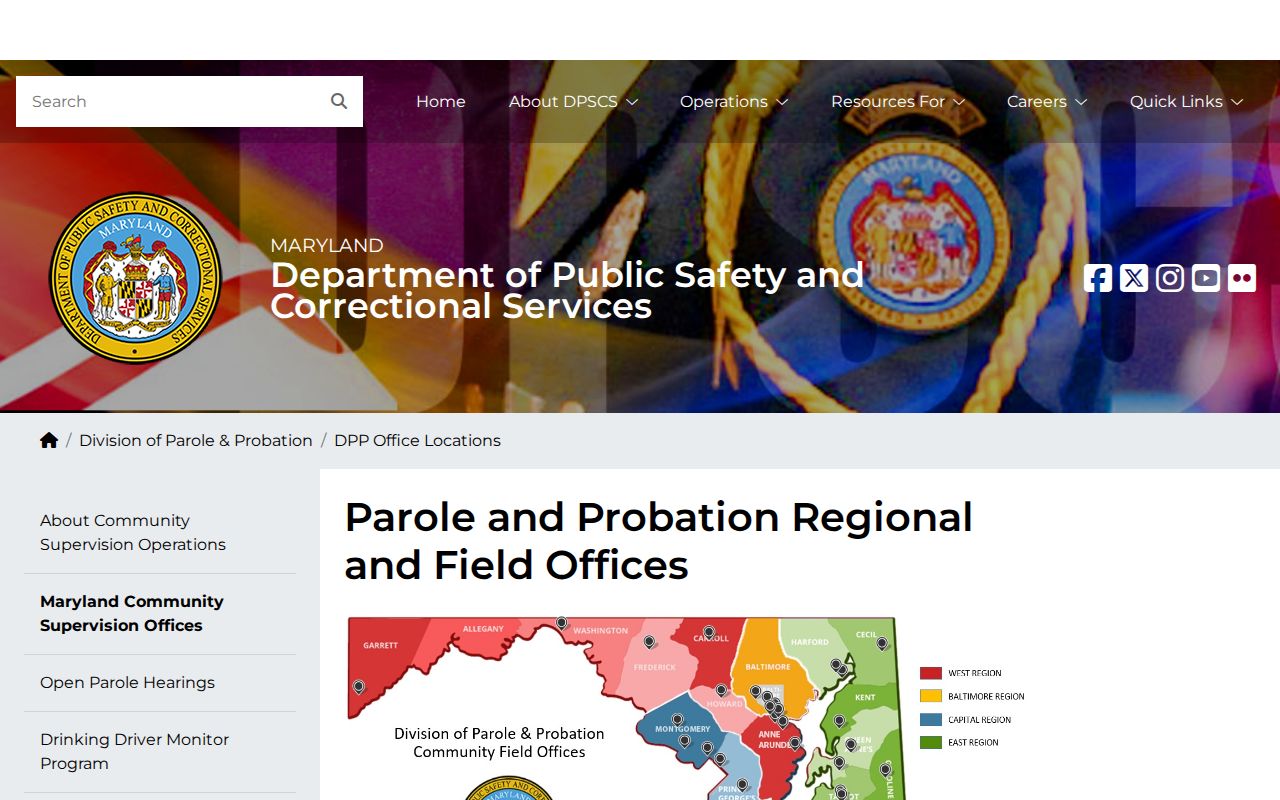
The directory image confirms that Frederick supervision is handled through a named Maryland DPP field office, not through a county jail roster.
Frederick County Probation Office
The official directory lists the Frederick Field Office/DDMP. DDMP identifies the Drinking Driver Monitor Program component within the office listing. Staff disclosure can be limited, so callers should provide enough identifiers to distinguish the right person and should ask for the correct record or office rather than requesting a broad personal history.
100 West Patrick Street
Frederick, MD 21701
Phone: 301-600-1935
Fax: 301-694-0632
DPP headquarters is at 6776 Reisterstown Road, Suite 212, Baltimore, MD 21215. Its listed phone numbers are 410-585-3500 and 877-227-8031. FCADC Pretrial Services, a separate county release track, can be reached at 301-600-3023. Calling the wrong office can produce an accurate answer about the wrong type of supervision. Confirm whether the case involves pretrial release, probation, parole, or mandatory supervision first.
Maryland VINE registration and DOC Victim Services written notification are separate. One registration does not create the other. A VINE registration also may not follow a person when the person moves from local detention to state prison or later enters parole or probation. Re-register at each documented system change and keep contact details current.
Frederick County Parole Decisions
Parole eligibility, a hearing, approval, and actual release are four distinct events. Correctional Services §7-301 is the starting point for eligibility. The general rule for a qualifying state sentence of at least six months begins consideration after one-quarter of the aggregate term, but violent-crime rules, mandatory portions, life sentences, repeat offenses, and sentence dates can change that point. Eligibility only allows consideration. It does not set a release date.
The Parole Commission describes common outcomes as refuse, rehear later, or approve subject to pre-release conditions. Under Correctional Services §7-308, parole is implemented by written order. A person remains in legal custody while serving the balance outside the facility if compliant, and the order is filed with the sentencing court. That makes the written order and DPP record stronger evidence than a meeting agenda.
Public Commission meetings, institutional hearing schedules, and person-level decisions must not be merged. The Commission’s public meetings are not a list of individual releases. Research found no public person-name decision database comparable to Case Search. A prior open-hearing master list was already stale by the research date, so current scheduling should be confirmed with MPC at 410-585-3200 or 877-241-5428.
Frederick County Supervision Violations
Conditions vary with the written order and sentence. At a high level, they can require reporting, compliance with court terms, and completion of directed programs. A violation can lead to agency action or a court process. An absconder label means the person is alleged to have stopped complying with supervision requirements. It does not establish that the person is inside Frederick County Adult Detention Center.
No comprehensive Frederick County absconder list was found in the official source sweep. Do not infer a warrant from a commercial page or an old news item. Check the matching court docket and contact the responsible DPP office or law-enforcement channel. A warrant may stay active even while the person remains in the community, and an arrest on that warrant starts a new custody question.
VINE can report some parole and probation events to registered users. The event should be read as a notice from the named system, not a full explanation of the underlying violation. Court records, a DPP response, and the actual jail record may all be needed when supervision action leads to custody. Note: A supervision alert never replaces direct confirmation when immediate safety or current custody status matters.
Frederick County Release Support
Frederick has a local reentry connection that sits beside, but does not replace, supervision. Project 103 describes Recovery Support Specialists who connect participating people with recovery resources upon release. CORE names both the Adult Detention Center and Parole and Probation among its partners and referral sources. These are navigation and recovery links. The source material does not support a promise that every released person qualifies.
A public naloxone box is located at the entrance to the Adult Detention Center, according to the county’s naloxone distribution information. This detail matters because leaving custody and entering treatment or supervision are separate transitions. A DPP appointment addresses legal supervision. A recovery referral addresses care and support. Neither is proof of the other.
People leaving the Frederick County Work Release Center may have already spent time in the community for approved activities while remaining in custody. Completion or termination of work release must still be confirmed through the Sheriff’s release record and court case. Community presence should never be mistaken for discharge from either custody or supervision.
Frederick County Supervision Discharge
Discharge is the record that closes a supervision term. It differs from parole release, probation placement, transfer between officers, or the end of physical confinement. A person may leave prison on parole or mandatory supervision and remain in legal custody until the full undiminished term ends. Probation can have its own end date and later court entries. Some people also have more than one case, so completion in one matter may not end every duty.
For probation, read the sentence and subsequent Frederick court docket. For parole or mandatory supervision, request the applicable DPSCS supervision and discharge record with the person’s identifiers. Ask for an existing record, not a new opinion. The Maryland Public Information Act, General Provisions Title 4, provides a request framework, but exemptions and redactions can limit disclosure. A written agency response is more reliable than interpreting absence from an online tool.
The end of supervision does not erase the court or release record. Expungement, shielding, and restricted access are separate legal processes. A record that no longer appears online can reflect lawful removal or a system boundary. It should not be treated as proof that the case, confinement, or supervision never existed.