
Frederick County Release Meaning
A Frederick County release is not one uniform event. The Frederick County Adult Detention Center may record a direct community release after bond, recognizance, dismissal, time served, sentence completion, parole, or another lawful order. It may also close its custody entry because the person moved to Maryland prison, another county, the US Marshals Service, or ICE. Only the first group clearly means the person returned to the community. The release-book entry, booking sheet, sentence record, detainer disposition, and transfer document may each hold part of the answer.
Work release and home detention require the same care. A participant can be outside the secure jail for approved work or another activity while still subject to a correctional order. Pretrial supervision also differs from probation, parole, and full discharge. A record search should identify the authority, the effective date, and the destination instead of treating every departure from a building as the same kind of Frederick County inmate release.
- Parole
- Conditional release from confinement while a sentence remains active under supervision.
- Probation
- Court-ordered supervision that may follow or replace a term in jail.
- Time served
- A sentencing result based on time already spent in custody, not the hour a person physically leaves.
- Discharge
- The end of the custody or supervision status named in the record.
Frederick County Inmate Release Types
The next search depends on the recorded release type. A court ruling can authorize release, yet processing, a warrant, or a detainer can keep the person in custody. Likewise, release from the county jail to a state or federal custodian is a transfer of responsibility, not proof that confinement ended.
| Release entry | What it means | Best next source |
|---|---|---|
| Bond or recognizance | The court allowed release under stated terms, subject to jail processing and any other holds. | FCADC release entry and court docket |
| Time served or sentence expiration | The local custody term ended, unless another authority takes custody. | Sentence calculation and release book |
| Parole or mandatory supervision | Confinement ended under continuing state supervision. | DPSCS and Division of Parole and Probation |
| Transfer to DOC or another jail | Frederick County physical custody ended, but incarceration continued. | Receiving agency and transfer record |
| ICE or federal handoff | Criminal custody may have ended while another legal custody began. | ICE, BOP, USMS, and the release record |
Dismissal, acquittal, or a nolle prosequi disposition can explain why a case no longer supports detention. Still, the court docket is not the jail clock. The actual Frederick County release date and time should come from the custodian’s record.
Frederick Pretrial Release Is Distinct
Frederick County Pretrial Services is a local community-supervision track, not state parole or sentence completion. The Sheriff’s 2023 report says Pretrial reviewed 1,327 people, prepared 210 bond reports, and completed 138 intakes. It also recorded three bond revocations and four failures to appear. These figures show that release before a final case result has its own record trail and conditions.
The District 11 criminal case plan schedules Frederick bail reviews at 1 p.m. on the next business day after arrest. That is the time set for a hearing, not a promised exit time. Confirm the judge’s ruling in the court case, then ask FCADC whether the person physically left and whether another hold remained. Call Pretrial Services at 301-600-3023 only when that program is the relevant status.
Note: A pretrial intake documents supervised release before case resolution; it does not show that a sentence has been served or discharged.
Frederick County Release Record Fields
No single form is guaranteed to contain every fact. Frederick County’s evidence can be spread across the booking sheet, commitment, release book, sentence calculation, classification notes, detainer record, transfer record, and court docket. A precise request names the records and asks for the fields that resolve the custody episode.
| Field | What it shows |
|---|---|
| Identity and record numbers | Legal name, birth date, booking number, local offender number, and any state identifier. |
| Admission and commitment | Arresting agency, admission time, committing court, case number, charge, and legal authority. |
| Sentence calculation | Sentence start, credit for time served, term structure, applicable credits, and calculated date. |
| Actual release | Physical date and time, release authority or type, and the staff or system entry. |
| Destination and holds | Community, DOC, another jail, ICE, USMS, supervision, or a detainer disposition. |
| Related materials | Booking photo, property or account disposition, instructions, and acknowledgments if maintained and releasable. |
The key is reconciliation. A docket can show legal authority. The release book can show physical movement. A receiving agency can show that custody continued elsewhere. Each item answers a different question about a Frederick County released inmate.
Request Frederick County Release Records
The Sheriff’s official route is the FCSO GovQuest records portal. It accepts public-record and photograph requests, provides status communication, and delivers available records. Request existing documents for one identified custody episode. Do not ask staff to create a new report or answer a broad research question.
- Give the full name, birth date, booking or offender number if known, facility, and custody date range.
- Ask for the booking sheet, commitment, release-book entry, sentence calculation, detainer disposition, and transfer destination.
- State that the request seeks the actual release date, time, authority, type, and any segregable nonexempt portions.
- Choose electronic delivery and request a fee estimate before costs pass a stated limit.
- Compare the produced record with the court docket and any receiving-agency result.
The FCSO records page lists a $5 base charge for an electronic incident report up to 20 pages, then $0.25 for each extra page. Photographs sent by email link or print have a $5 charge, and printed photos above 20 cost $0.25 each. USB media cost $20, while GovQuest lists a $3.50 convenience fee. Search, review, and redaction time can add cost under the stated policy. Call records assistance at 301-600-1740 or visit 110 Airport Drive East, Frederick, MD 21701.
Frederick Release Records and MPIA
The Maryland Public Information Act appears in General Provisions Title 4. Section 4-201 provides the general inspection rule subject to the Act. Sections 4-202 and 4-203 address applications and agency responses. Section 4-206 governs reasonable fees and generally provides the first two hours of search and preparation without that charge. Section 4-351 can permit withholding of qualifying law-enforcement records when its conditions apply.
Judicial records follow Maryland court access rules rather than the Sheriff’s executive-agency request path. Juvenile, sealed, shielded, and expunged material should never be assumed public. Internal retention is also different from public web display. Frederick County has no official released-person roster whose display period can be measured, so no online retention period should be guessed.
Missing Frederick Release Records
A missing old result does not prove that an arrest or Frederick County custody episode never occurred. The Maryland Case Search FAQ says Frederick criminal data begins March 13, 2000, but expungement, shielding, restricted access, name variation, and incomplete online detail can all affect a search. Case records may otherwise remain visible long after a short jail stay.
The Sheriff’s Records Section reported processing 341 expungements in 2023. That figure shows that lawful record removal has a local operational effect. The Maryland Judiciary expungement resource supplies current forms and rules, while the Frederick District Court Help Center offers free limited assistance on weekdays. Expungement can affect both court and law-enforcement records, so a search result should be described only within the scope of the system checked.
Note: Shielding and expungement are distinct legal processes, and neither should be replaced with an assumption based on a blank search screen.
Frederick Booking Versus Release
Central Booking processed 2,503 people in 2023, but only 1,244, or 49.70 percent, were committed to detention. A booking therefore does not prove that the person joined the standing jail population. Some people may leave after processing, an initial appearance, recognizance, bond, or another short sequence. The right evidence is the booking sheet paired with the actual release entry and court case.
The same annual report separates release-book updates from releases to Maryland DOC. That split matters. A DOC movement ends Frederick County physical custody but continues imprisonment in the state system. A recent booking image or news post cannot establish either the release date or the later destination.
Frederick Release System History
The Frederick County Adult Detention Center opened in October 1984, expanded in the 1990s, and added a 128-bed Work Release Center in June 2005. Those changes help explain why secure detention, Central Booking, pretrial activity, home detention, and work release can produce different records within one county corrections operation.
The 2023 Corrections Bureau report described a planned Black Creek jail-management system intended to track a stay from intake through release. It also described medical and infrastructure work as plans current to that report. Those statements are historical planning evidence, not confirmation that every project was completed. For a present release, ask for the existing record by name rather than assuming what software now stores it.
Frederick Sentence and Release Records
Frederick’s Records Section counted 684 sentence calculations and 412 release-book updates in 2023. Inmate Services separately counted 74 release interviews and 93 releases to DOC. These categories give a requester precise terms. Ask for the sentence calculation when the question is when a local term should end, the release-book entry when the question is when the person actually left, and the destination or transfer record when custody may have continued.
A projected date is not the same as an actual release time. Credits, amended sentences, warrants, detainers, parole action, and another consecutive term may change the outcome. A Frederick County inmate release date calculation must remain distinct from the final physical event recorded by the custodian.
Find Frederick County Released Inmates
Start with the system that last held the person. Frederick County does not publish an official public jail roster, released-booking archive, or 24-hour or 72-hour release feed. Roster disappearance therefore cannot serve as proof. For a person last held at FCADC, use the court case, a direct jail inquiry, and the release-book record together.
- Search Maryland Judiciary Case Search by name or case number, then read the disposition, sentence, and later docket entries.
- Call FCADC Offender Records at 301-600-3015 with a full name and identifier. Ask whether the person physically left and where custody went.
- For work release, home detention, or pretrial status, contact the relevant unit without treating community presence as discharge.
- Check Maryland VINE for a custody event when the registration and reporting agency match.
- Submit a GovQuest request for the release-book entry and related existing records when documentary proof is needed.
If the record shows transfer, switch systems. A Maryland DOC transfer becomes a DPSCS question. Federal imprisonment belongs in BOP. Current immigration detention belongs in ICE ODLS. The source agency and destination control the next check.
Maryland Search After Frederick Release
The DPSCS Incarcerated Individual Locator is a current-custody locator. Its official scope says it shows facility locations for covered people currently held in specified Maryland correctional settings. It expressly excludes people no longer in custody for any reason, including release or escape. It does not provide a released archive, release date, projected date, or supervision status.
| Search field | Type | Use and limit |
|---|---|---|
| First name | Name | Use the known spelling; a mismatch can produce no result. |
| Last name | Name | Required identifying field on the public form. |
| Returned location | Result | Shows a covered present facility, not a historical discharge. |
The official locator screen shows the tool’s current-custody scope.
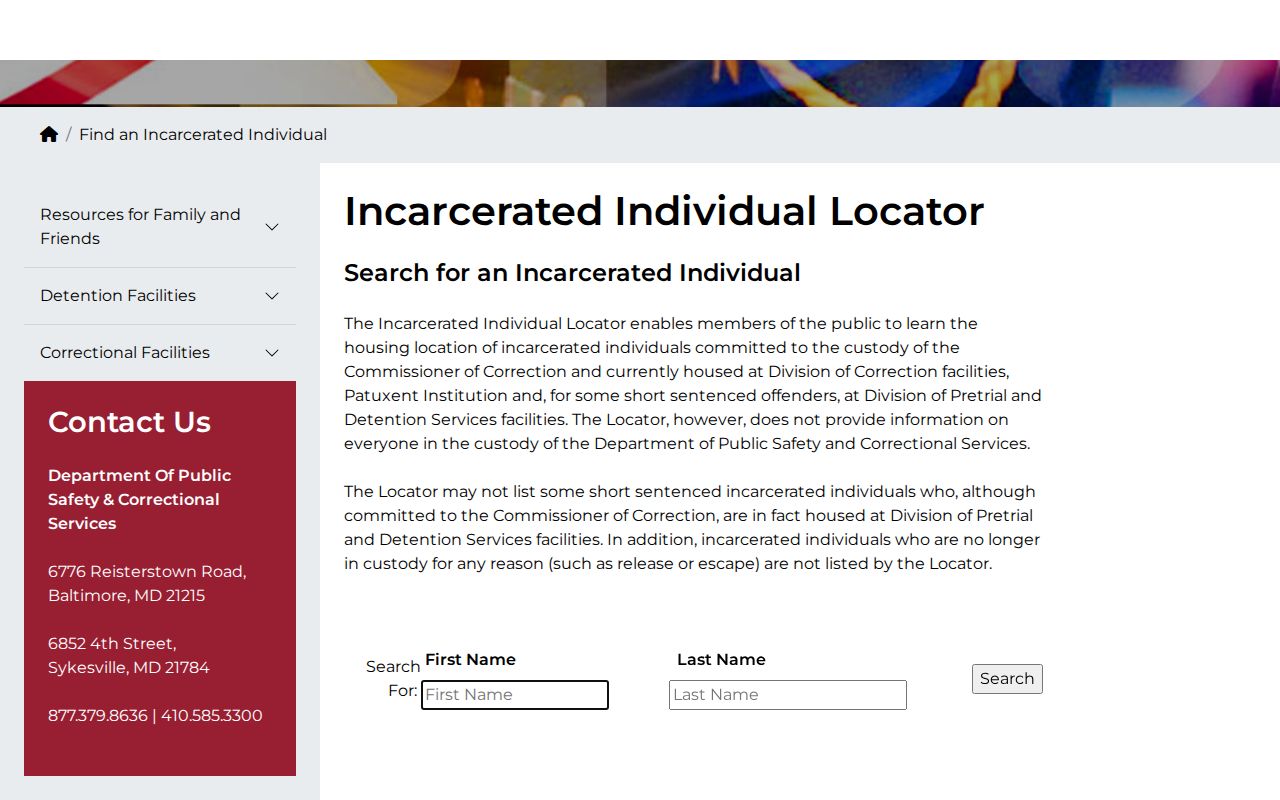
The screen supports a current facility check, but a blank result must be reconciled through VINE, the court case, parole and probation contacts, and a DPSCS records request.
Frederick Release and Court Records
Frederick District and Circuit courts share the courthouse at 100 West Patrick Street, but they handle different case work. District Court handles misdemeanors and certain felonies without jury trials. Circuit Court handles felony, jury, and other matters within its jurisdiction. Case Search can preserve charge, disposition, sentence, schedule, and docket history long after county custody ends.
A court order explains legal authority, not necessarily the physical exit time. A recognizance decision may still be followed by release processing or another hold. Maryland VINE also requires a new registration when a case moves between District and Circuit Court. Match the docket to the FCADC release entry, and contact the clerk for the official record when public electronic detail is incomplete.
Frederick Release to ICE
Frederick County’s 287(g) Jail Enforcement agreement makes one wording choice crucial: release from criminal custody may be a handoff to ICE rather than a return to the community. The agreement addresses service of an immigration warrant at scheduled criminal release. An FCSO press release also documented people granted recognizance who remained held because of ICE detainers.
Call the FCADC ICE Information line at 301-600-6829 when the county record points to an immigration handoff. Then use the ICE Online Detainee Locator for current covered custody. It searches by a nine-digit A-number plus country of birth, or by exact name, country of birth, and optional birth date. No result is not proof of release. Exact names, scope limits, and transfer timing can all affect the search.
Note: “Released to ICE” closes one custody ledger while opening another, so it should never be summarized as a community return.
Frederick Release Across Other Systems
Maryland VINE supplies custody, court, parole, probation, and related event notifications for participating sources. It is not a complete historical archive. Registration must be renewed when a person moves from local detention to state prison, enters parole or probation, or when a case changes court level. A released or out-of-custody event describes the reporting agency, not every possible hold.
For federal imprisonment, use the BOP Inmate Locator. It generally covers federal records from 1982 forward and can return a release date plus “Released” or “Not in BOP Custody.” That status does not rule out local, state, immigration, USMS, parole, or federal supervised-release status. USMS has no matching public historical locator, so its custody record may require the federal docket and a USMS FOIA request.
The official BOP search form identifies the federal lookup fields.
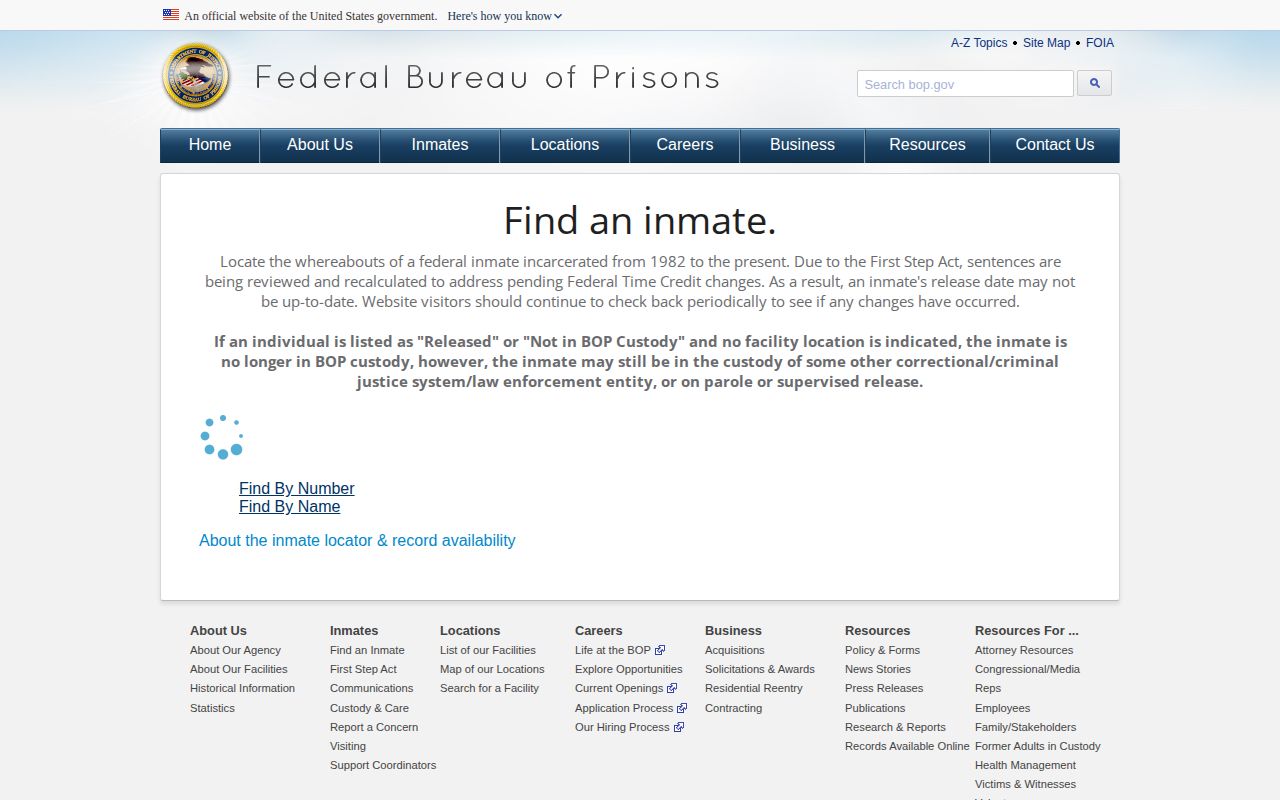
This federal tool is relevant only when the person entered BOP custody; it does not replace the Frederick County release book.
Frederick Release Search by Status
Choose a source for the status it actually records. A current locator, release record, court case, and notification service are not interchangeable. The most reliable conclusion comes from matching the legal event, physical release entry, destination, and any later supervision or custody.
| Status or system | What to use | What it can prove |
|---|---|---|
| Current FCADC custody | Offender Records or main jail line | Present physical status, subject to staff disclosure limits |
| Released from FCADC | Release book, booking sheet, and court docket | Actual county release time, authority, and destination |
| Maryland prison custody | DPSCS locator | Covered current state facility only |
| Parole, probation, or notifications | DPP, VINE, and the court case | Applicable supervision or event information |
| Federal or immigration custody | BOP, USMS records, or ICE ODLS | Status within that agency’s stated scope |
Why is a released person missing from a roster? A live roster is meant to show current custody, so a person normally leaves it after that custody closes. Frederick County does not publish such an official roster. Use the underlying release record, not an assumed roster history.
Frederick Resources After Release
Frederick County has a local recovery-support layer tied to the custody transition. Project 103 is a substance-use treatment program inside FCADC, and its Recovery Support Specialists connect participating people with recovery resources upon release. No eligibility beyond the official description should be assumed.
CORE provides peer, family, and community recovery support and identifies the Adult Detention Center and Parole and Probation among partner or referral sources. The Health Department also identifies a public naloxone box inside the ADC entrance at the end of the sidewalk by the facility signage. These are health and navigation resources, not evidence of a person’s custody status.
The official Criminal Justice Services page describes the local release-resource connection.
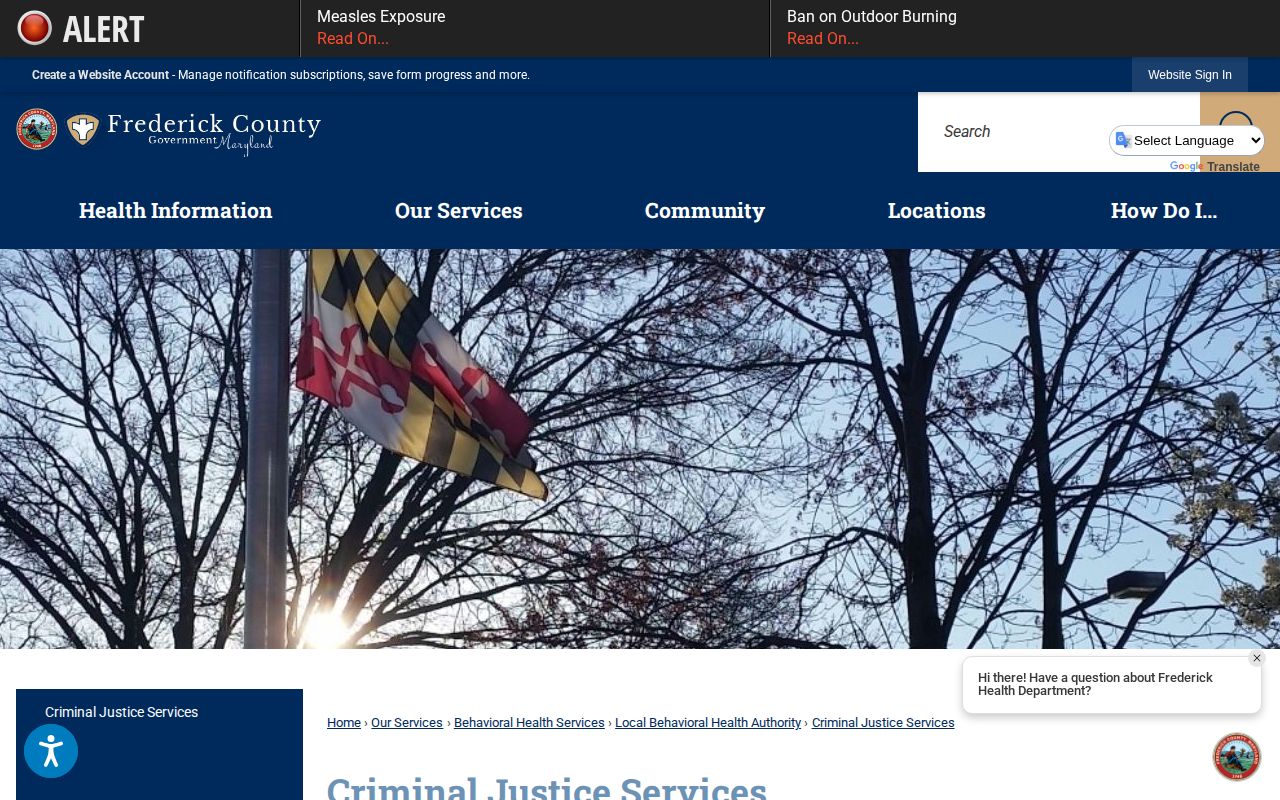
The county program page helps locate support around release while the Sheriff, court, and corrections records remain the sources for release verification.
Frederick County Release Facilities
Two adult county correctional facilities belong in the Frederick County release path. The Frederick County Adult Detention Center is the primary jail for Central Booking, pretrial detention, local sentences, records, and transfers. Its direct community releases must be separated from moves to DOC, ICE, another jurisdiction, or supervision.
The Frederick County Work Release Center administers work release, home detention, labor, and community-service activity. Approved presence outside the building does not itself mean discharge. Confirm whether the placement was completed, terminated, revoked, returned to secure custody, or transferred by obtaining the termination or release record and checking the court docket.